Why we backed Perleybrook
Every industrial site in the world has a safety problem and a labor-shortage problem. Perleybrook builds AI-powered vision systems that solve both — replacing rooms full of human safety monitors with continuous, accurate, frame-by-frame computer vision that catches incidents before they become injuries.
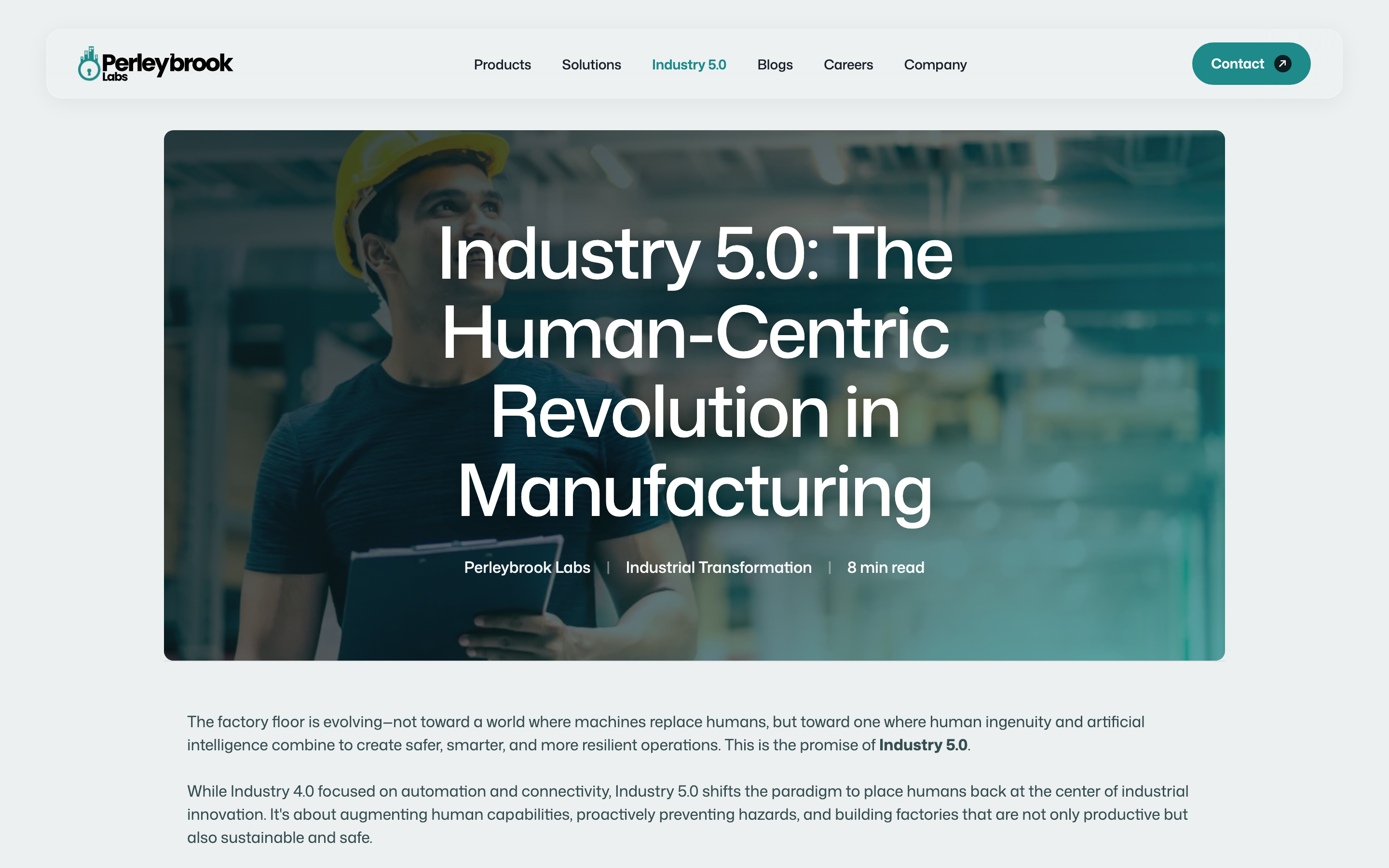
Industry 5.0 safety automation for human-centric manufacturing.
The company
Perleybrook builds AI-powered vision systems for industrial safety and operations automation. Boston-headquartered, the company sells to industrial enterprises — heavy manufacturing, food processing, EPC construction, logistics, mining — where the cost of safety incidents is catastrophic and the available pool of human safety monitors is structurally shrinking. The product reads existing on-site camera feeds and detects PPE non-compliance, restricted-zone breaches, near-miss events, and operational anomalies in real time.
Why we backed them
The conventional industrial-safety pitch in 2023 was that the right answer was more cameras and more alerts — bolt computer vision onto existing CCTV and surface incidents to the EHS team. The flaw in that pitch was that EHS teams were already overwhelmed; adding more alerts to their dashboard made the problem worse, not better.
Perleybrook's architecture is different. The system doesn't just detect events; it triages them, suppresses noise, and surfaces only confirmed, contextualized findings to the human reviewer. The 96% of alerts that are noise stay invisible. What reaches a human is already a confirmed safety event with full context assembled.
Three reasons we leaned in.
First, the buyer pain is acute and the willingness to pay is high. A single OSHA citation costs more than a year of Perleybrook's subscription. A single fatality costs more than a decade of it. Industrial safety leaders are not price-sensitive when the alternative is the next incident at their worst plant.
Second, the technical moat compounds with deployment. Every additional camera the system sees, every additional plant it learns, every confirmed and dismissed event in a customer's environment makes the model better in that customer's environment. Switching costs are real and growing.
Third, the founders bring the rare combination of computer-vision research depth and industrial-domain credibility. They were not academics looking for a problem; they had operated inside the kinds of organizations Perleybrook now sells to.
What we did beyond capital
We made introductions to industrial-buyer networks across the US — heavy manufacturing, EPC, logistics — through the Callapina diaspora corridor. We helped sharpen the positioning that distinguishes Perleybrook from generic computer-vision vendors and from incumbent EHS-software providers. We supported the next financing round with introductions to industrial-AI-focused funds.
The Callapina conviction
Perleybrook expresses our DeepTech conviction in its purest form: AI applied to a domain where the stakes are physical, the moat compounds with deployment, and the customer profile is structurally sticky. The China-plus-one industrial reshoring tailwind is making the buyer base larger, not smaller. Perleybrook is positioned to capture that wave.
— Vinod Jose, Founding GP
More portfolio case studies
Why we backed Sector Qube
There are 30 million commercial padlocks deployed across global supply chains, warehouses, transport corridors, and energy infrastructure. Almost none of them are intelligent. Sector Qube is rebuilding that layer with smart locks that turn every shipment, every facility, and every asset into a continuously-monitored data point.
Why we backed DeepIQ
Most AI companies in 2024 told a story about the foundation models. DeepIQ told a story about the unglamorous middle: the messy, multi-decade-old SCADA and historian data that runs every refinery, utility, and mine on earth — and the fact that no one had built a no-code DataOps layer that could turn that data into something AI could actually use.
Why we backed Sastra Robotics
Sastra is solving a problem that almost no one in the consumer technology world thinks about, and almost everyone in the regulated industrial world is pricing out: how do you automate the testing of physical interfaces — the touchscreens, control panels, and HMI systems — that mediate every cockpit, vehicle dashboard, surgical device, and factory line on earth?
See the company overview, traction signals, founder perspective, and related diligence context.