Why we backed DeepIQ
Most AI companies in 2024 told a story about the foundation models. DeepIQ told a story about the unglamorous middle: the messy, multi-decade-old SCADA and historian data that runs every refinery, utility, and mine on earth — and the fact that no one had built a no-code DataOps layer that could turn that data into something AI could actually use.
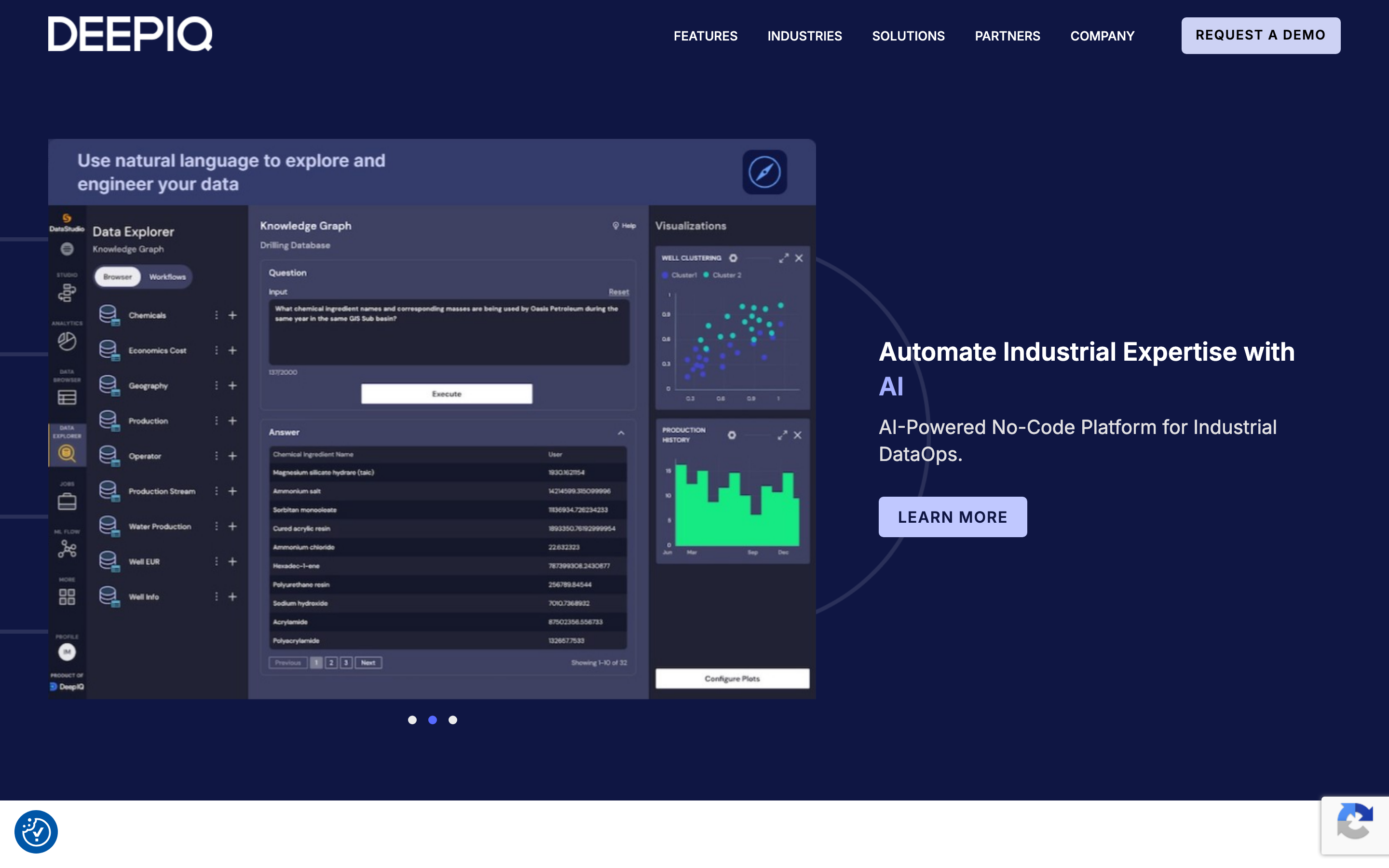
No-code DataOps + AI for industrial operations.
The company
DeepIQ is a no-code DataOps and AI platform built specifically for industrial data — the operational technology, sensor, historian, and SCADA data that runs the world's energy, utilities, manufacturing, and mining infrastructure. Headquartered in Houston, DeepIQ serves a customer base of upstream oil and gas operators, midstream pipeline companies, utility operators, and heavy-industry asset managers.
The product lets an industrial customer unify their fragmented data — typically spread across OSIsoft PI, Aveva PI, multiple SCADA systems, and a half-dozen vendor-specific data lakes — and ship machine-learning use cases over that unified data layer in weeks rather than the eighteen-to-twenty-four-month timelines typical of traditional industrial-AI deployments.
Why we backed them
The case for DeepIQ rested on a structural observation about industrial AI that the venture market in 2022 was systematically misreading.
Every industrial CEO in the world had been told by their board that they needed an "AI strategy." Most responded by hiring a chief data officer and assigning the problem to a team of consultants. What those teams discovered, almost universally, was that the bottleneck was not the AI models. The bottleneck was the data engineering required to make the underlying operational data usable in the first place. Sensor streams in inconsistent formats. Historian databases that no one had migrated in fifteen years. Tag dictionaries built ad-hoc by a series of plant managers, half of whom had retired. And every consulting engagement quoted a six-figure data-engineering budget before any AI work could even begin.
DeepIQ built the layer that turned this twelve-month problem into a four-week problem. The platform's no-code DataOps tooling lets industrial engineers — not specialist data engineers — wire up data pipelines, transform sensor streams, and ship models, all without leaving their domain expertise.
Three reasons we leaned in.
First, the customer pain was severe and the willingness to pay was high. Industrial operators are not price-sensitive when the alternative is a stalled AI initiative that the board is asking about quarterly. Average contract values reflect that.
Second, the product unlocks a market that traditional industrial AI vendors structurally cannot. The biggest players in industrial AI sell large, multi-year systems-integration deals with significant professional-services components. DeepIQ sells software that pays back in weeks. That is a fundamentally different motion that captures a fundamentally different segment.
Third, the founding team had the rarest combination in industrial software: deep domain expertise in OT data, modern software engineering discipline, and the patience to sell into a notoriously slow buyer base. DeepIQ's CEO and founders had built careers in this exact problem space before starting the company.
What we did beyond capital
We worked with the DeepIQ team on two specific dimensions.
We made introductions to industrial operators and digital-transformation leaders in our network — particularly in heavy industries like Mining.
We helped frame the DeepIQ pitch for board-level audiences — the CEOs and CDOs who set AI strategy at industrial customers. The product is technical, the buyer is not always technical, and bridging that gap is critical for an enterprise-software company at this stage.
The Callapina conviction
DeepIQ sits at the intersection of two of our four conviction pillars — vertical AI applied to industrial data, and the manufacturing-and-energy buildout that the China-plus-one realignment is accelerating. We believe the next decade will see industrial customers spend hundreds of billions on data and AI infrastructure that, today, almost no Western SaaS company has been built to serve. DeepIQ is among the small handful of companies positioned to capture that spend.
— Vinod Jose, Founding GP
More portfolio case studies
Why we backed Perleybrook
Every industrial site in the world has a safety problem and a labor-shortage problem. Perleybrook builds AI-powered vision systems that solve both — replacing rooms full of human safety monitors with continuous, accurate, frame-by-frame computer vision that catches incidents before they become injuries.
Why we backed Sector Qube
There are 30 million commercial padlocks deployed across global supply chains, warehouses, transport corridors, and energy infrastructure. Almost none of them are intelligent. Sector Qube is rebuilding that layer with smart locks that turn every shipment, every facility, and every asset into a continuously-monitored data point.
Why we backed Sastra Robotics
Sastra is solving a problem that almost no one in the consumer technology world thinks about, and almost everyone in the regulated industrial world is pricing out: how do you automate the testing of physical interfaces — the touchscreens, control panels, and HMI systems — that mediate every cockpit, vehicle dashboard, surgical device, and factory line on earth?
See the company overview, traction signals, founder perspective, and related diligence context.