Why we backed Bynry
There are over one hundred thousand small and mid-sized water, electric, and gas utilities in North America, and almost every one of them is running customer-information software that was written before the iPhone was invented. Bynry is the AI-native platform that finally makes their modernization economically viable.
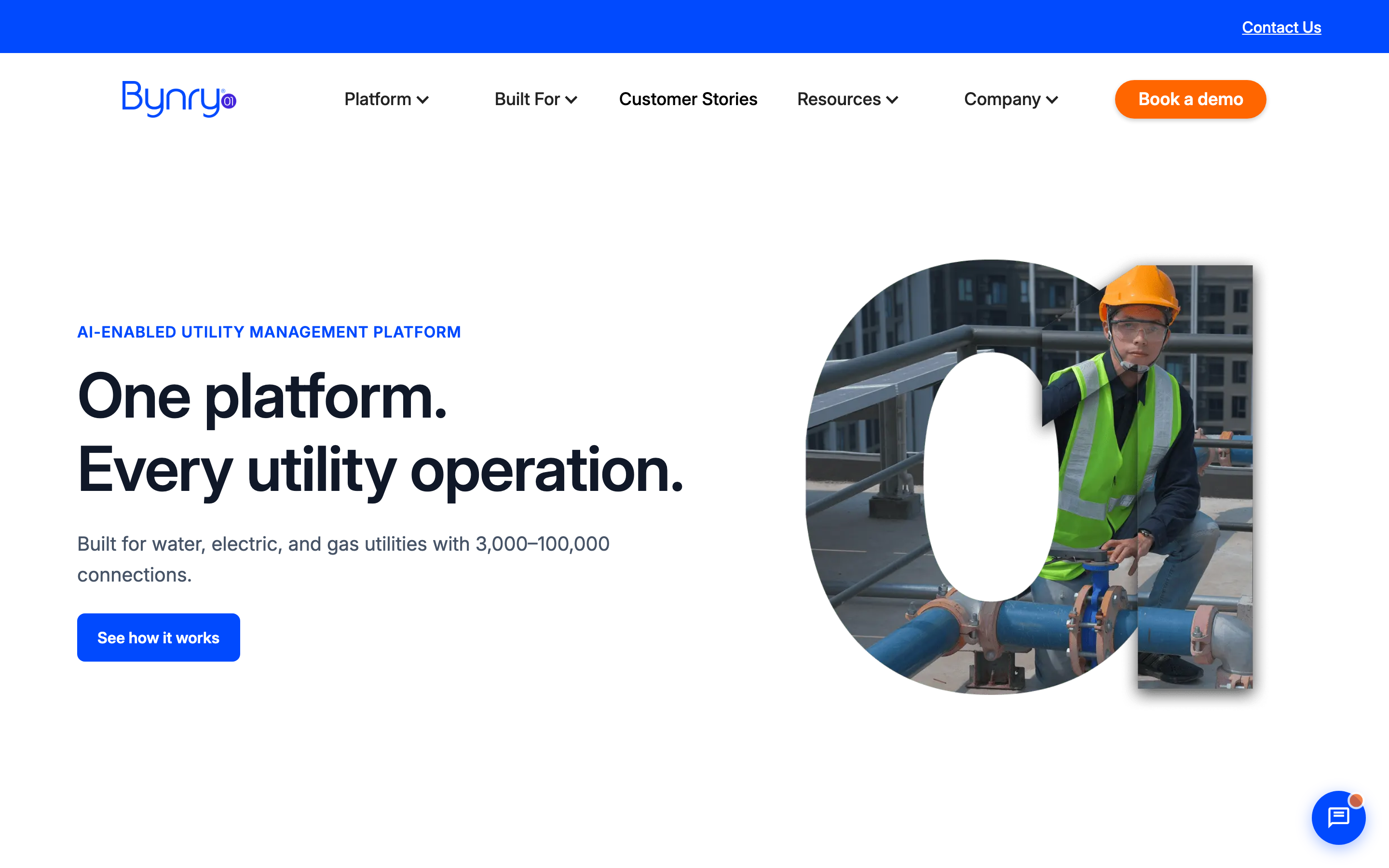
SMART360 — AI-native utility management platform.
The company
Bynry's flagship product, SMART360, is a cloud-native, AI-native utility management platform built specifically for utilities in the 3,000 to 100,000 meter range that serve the long tail of North American water, electric, and gas customers. These are typically municipal entities or cooperatives, and they are systematically locked out of the enterprise software stacks that SAP and Oracle sell to the largest utilities.
Bynry's platform unifies customer information, billing, meter data management, asset management, service orders, and customer engagement into a single modular system. The deployment timeline — 20 to 24 weeks from contract signature to full production go-live — is the company's structural moat versus the 12 to 18 month cycles common in legacy CIS programs. Bynry's revenue model is a transparent pay-per-meter subscription that eliminates the seven-figure license fees and multi-year customization cycles that have historically priced these customers out of modernization.
The company is targeting a $10 billion addressable modernization market across the broad North American utility long tail. Its public flagship deployment, Samoa Water Authority, serves 35,000+ consumers. The platform achieved 99% billing accuracy, processed 40,000+ bills through the system, and recovered $3.2 million in previously unbilled or disputed revenue within the first operational year.
Why we backed them
The investment case for Bynry rests on a structural argument about how vertical SaaS reaches under-served markets.
The North American utility software market has, for decades, looked like a barbell: at one end, large utilities buy from SAP and Oracle for tens of millions of dollars; at the other end, small utilities run on twenty-year-old, on-premise software that nobody has the budget to replace. The middle was effectively empty. Every attempt to serve the middle failed because the unit economics did not work — implementation services consumed any margin the licensing produced.
Bynry's wedge is that AI compresses both the implementation timeline and the operating cost structure. Generative AI handles legacy data migration via OCR and template-based ingestion. At Samoa Water Authority, consumer complaint volume reduced 35% within the first billing cycles, the meter-to-bill cycle improved by 38%, and report generation became 80% faster. Each of those operational improvements directly reduces the cost of serving a small utility, and together they make a previously impossible business model possible.
Three reasons we leaned in.
First, the founder is uncommon. Nilesh founded Bynry in 2022 after deep customer engagement showed where product-market fit actually lived in specialized utility SaaS. That customer-led path produces founders who know their market with a precision that hypothesis-led founders rarely match.
Second, the moat is regulatory-and-domain-driven, not just technical. Selling software into North American municipal utilities requires trust, compliance, and political relationships. Bynry has assembled a US advisory board including a former Utility Commissioner — Swati Dandekar — that gives the company the regulatory credibility most foreign-built vendors lack.
Third, the commercial model targets a healthy SaaS shape. Bynry combines contract durations of three to five years, 100% customer retention, and a tiered pay-per-meter expansion path. The land-and-expand motion is built into the product's pricing tiers.
What we did beyond capital
We worked with the Bynry team on three priorities.
We supported the US go-to-market structure. Bynry's transition from being an Indian-engineered company to a credible US enterprise vendor required intentional repositioning of the company's headquarters narrative, advisory board, and field-sales motion. We contributed to that transition.
We made introductions in the US utility ecosystem — both to potential customers and to operators in adjacent infrastructure software companies who could provide hiring leads and partnership signals.
We helped frame the AI narrative for the next financing round. Bynry's AI capabilities are not the marketing veneer you find in most vertical SaaS companies — they are core to the unit economics. We worked with the team on positioning that distinction for sophisticated investors.
The Callapina conviction
Bynry is a textbook expression of one of our core convictions: that the next decade of vertical SaaS is being built by founders who are using AI to make economically impossible markets economically viable. North American utilities have been an untapped pool for as long as enterprise software has existed; Bynry is the first credible attempt at unlocking it.
— Vinod Jose, Founding GP
More portfolio case studies
Why we backed Orca AI
B2B customer teams are drowning in disconnected account signals — support tickets, success notes, product usage, sales context, and renewal risk. Orca AI is the layer that turns those signals into a customer-decision substrate.
Why we backed Skydda
On April 7, 2026, an AI model read the Linux kernel and found vulnerabilities thousands of human engineers had missed for decades. The defender's edge in the world that announcement created is no longer about scanning faster — it is about knowing your specific business deeply enough to detect a patient, business-aware attacker.
Why we backed Runo
Runo is the kind of company that the conventional VC model misses entirely. It is profitable. It is unsexy. It serves Indian MSMEs whose CIO no one has ever heard of. And it is one of the highest-return-per-dollar SaaS businesses in our portfolio.
See the company overview, traction signals, founder perspective, and related diligence context.