Why we backed Orca AI
B2B customer teams are drowning in disconnected account signals — support tickets, success notes, product usage, sales context, and renewal risk. Orca AI is the layer that turns those signals into a customer-decision substrate.
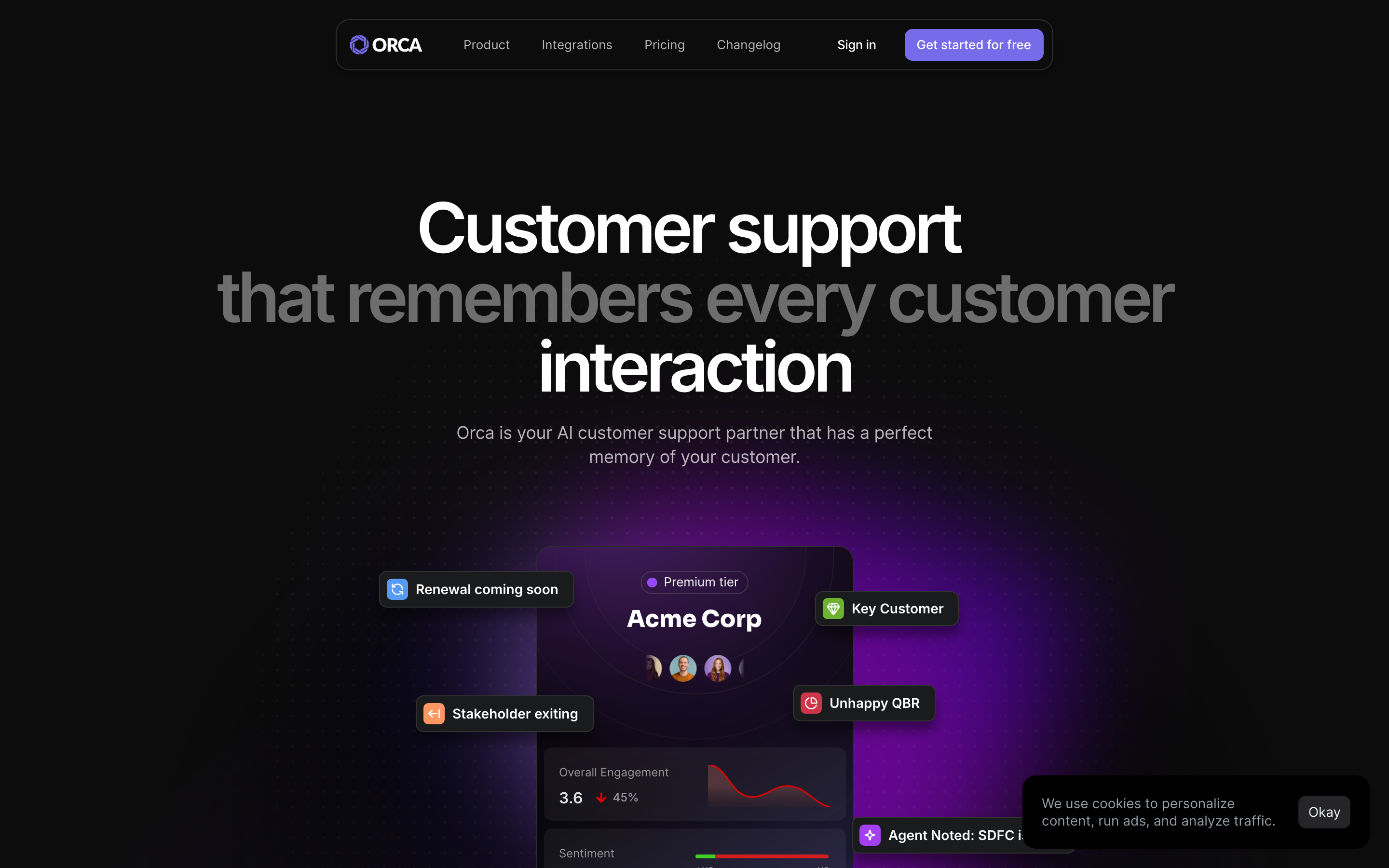
Account context — synthesis across support, success, product usage, and sales signals.
The company
Orca AI is an account-based customer-experience platform that ingests a B2B company's support tickets, product usage, customer-success notes, sales context, and account history — and turns them into structured customer-decision signal. SFO-headquartered, sold to B2B customer teams. Every SaaS company has customer data; very few teams can act on it with context. Orca AI closes that gap.
Why we backed them
The pitch we heard early in 2024 was that the bottleneck for modern product teams was no longer data collection — every team had Amplitude or Mixpanel, every team had support transcripts, every team had user research. The bottleneck was synthesis. Ten dashboards, six tools, three Slack channels, a notion doc somebody wrote and forgot — and a PM trying to decide what to build next quarter.
Three reasons we leaned in.
First, the product wedge was right. Orca AI does not ask the customer to migrate platforms or rip out their existing stack. It connects to systems like Zendesk, Salesforce, product analytics, and customer-success tools via API and surfaces the cross-source signal — what users are complaining about, what is correlated with churn, which accounts are at risk, and what support teams should know before they respond. Time-to-value is measured in hours, not weeks.
Second, AI changed the unit economics. Before LLMs, this synthesis required a small army of customer-success analysts. Orca AI runs the synthesis at a fraction of the cost, with quality that approaches a senior customer operator. The category exists now in a way it did not three years ago.
Third, the founders are operators. They built and shipped product at companies where the synthesis problem was acute — and they built Orca AI as the tool they wished they'd had.
What we did beyond capital
We made introductions in the B2B SaaS ecosystem — product, support, and customer-success leaders at our diaspora-network companies who could become early design-partner customers. We helped frame the buyer narrative for teams evaluating "yet another AI support tool" and showed how Orca AI's positioning as a customer-decision substrate rather than a dashboard changed the procurement conversation. We supported the team on the next financing round, with introductions to growth-stage funds focused on B2B SaaS and AI workflow automation.
The Callapina conviction
Orca AI sits at the intersection of two of our convictions — vertical AI applied to a workflow where the moat compounds with proprietary integration depth, and SaaS that uses LLMs to make a previously-too-expensive job economically viable. The customer-support and success buyer has not historically been served well by account-aware AI tooling; that is changing fast, and Orca is one of the small handful of companies positioned to define the category.
— Vinod Jose, Founding GP
More portfolio case studies
Why we backed Skydda
On April 7, 2026, an AI model read the Linux kernel and found vulnerabilities thousands of human engineers had missed for decades. The defender's edge in the world that announcement created is no longer about scanning faster — it is about knowing your specific business deeply enough to detect a patient, business-aware attacker.
Why we backed Bynry
There are over one hundred thousand small and mid-sized water, electric, and gas utilities in North America, and almost every one of them is running customer-information software that was written before the iPhone was invented. Bynry is the AI-native platform that finally makes their modernization economically viable.
Why we backed Runo
Runo is the kind of company that the conventional VC model misses entirely. It is profitable. It is unsexy. It serves Indian MSMEs whose CIO no one has ever heard of. And it is one of the highest-return-per-dollar SaaS businesses in our portfolio.
See the company overview, traction signals, founder perspective, and related diligence context.