Why we backed Sastra Robotics
Sastra is solving a problem that almost no one in the consumer technology world thinks about, and almost everyone in the regulated industrial world is pricing out: how do you automate the testing of physical interfaces — the touchscreens, control panels, and HMI systems — that mediate every cockpit, vehicle dashboard, surgical device, and factory line on earth?
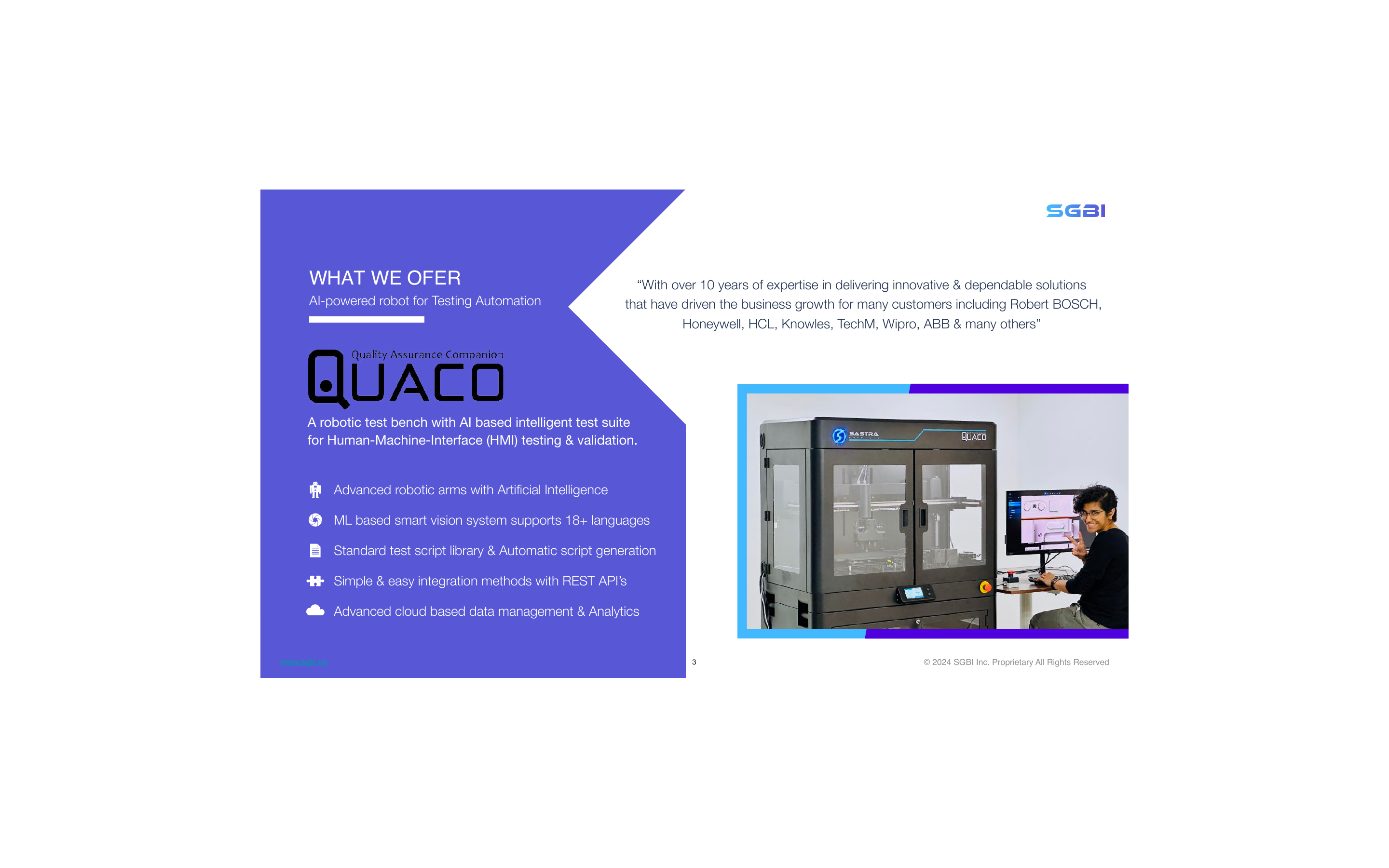
QUACO platform for automated testing of physical interfaces.
The company
Sastra Robotics builds robotic systems for the automated testing of physical interfaces — the touchscreens, control panels, and human-machine interfaces (HMIs) embedded in everything from cockpits to operating-room equipment to factory floors. Headquartered in San Francisco with engineering in Cochin, Sastra serves aerospace OEMs, automotive Tier 1 suppliers, medical device makers, and industrial equipment manufacturers — the kind of customers for whom a single missed bug in a control interface can mean a regulatory recall.
Why we backed them
The pitch we heard in 2021 was technically narrow but commercially huge. Today, when an aerospace OEM ships a new cockpit avionics system, a small army of human QA engineers physically presses every button, every touchscreen surface, every dial, in every conceivable sequence, and certifies that the system behaves as designed. The same is true for surgical control panels, automotive HMIs, and industrial control rooms. That manual labor cost is rising every year, certification cycles are compressing, and the available QA-engineer talent pool is contracting.
Sastra's robots replace that labor with repeatable, six-axis robotic actuators that press, swipe, and interact with physical interfaces at scale, generating audit-grade test logs. The math is brutal — Sastra's customers reduce certification-cycle QA labor by 60–80% while improving coverage.
Three reasons we leaned in.
First, the technical moat is real. Building a robotic test rig that can interact with a touchscreen the way a human finger does is significantly harder than it looks. Sastra has been compounding kinematics, force-feedback control, and computer-vision validation for years. Catching up to that is a multi-year, multi-million-dollar exercise for any new entrant.
Second, the customer profile is exactly right. Aerospace, automotive, and medical-device OEMs are slow buyers but extraordinarily sticky. Once a Sastra rig is integrated into a customer's QA pipeline, replacing it requires re-certifying the test process — which is functionally never going to happen. Net retention in this segment is structurally above 100%.
Third, the founders are exceptional. Aronin and his team had been building this technology with discipline for years before we met them. They had the patience that DeepTech demands and the customer-led product instincts that DeepTech often lacks.
What we did beyond capital
Sastra was a textbook case for what the Callapina diaspora-corridor network can do for a DeepTech founder.
We made introductions into the US aerospace and medical-device buyer networks — operators in Honeywell, Garmin, and adjacent OEMs whose QA teams are exactly Sastra's customer profile. Several of those introductions converted to paying contracts.
We worked on the bridge between the US sales motion and the Indian engineering footprint. Sastra's engineering and manufacturing concentration in Cochin is a structural cost and talent advantage; we helped articulate that position to US enterprise buyers in a way that turned the geography into a credibility lever rather than a question mark.
We supported the team on commercial structuring of multi-rig deployments — the move from single-rig pilots to fleet-scale rollouts is the financial inflection point for the company, and we contributed framing on how to price and contract that transition.
The Callapina conviction
The "China-plus-one" supply chain shift is a multi-decade tailwind for industrial DeepTech companies built on Indian engineering. Sastra is the exact kind of company that benefits — global customer base, premium engineering, manufacturing efficiency. We backed them because we believe DeepTech with a manufacturing edge is one of the four investable convictions for the next decade, and Sastra is one of the strongest expressions of it.
— Vinod Jose, Founding GP
More portfolio case studies
Why we backed Perleybrook
Every industrial site in the world has a safety problem and a labor-shortage problem. Perleybrook builds AI-powered vision systems that solve both — replacing rooms full of human safety monitors with continuous, accurate, frame-by-frame computer vision that catches incidents before they become injuries.
Why we backed Sector Qube
There are 30 million commercial padlocks deployed across global supply chains, warehouses, transport corridors, and energy infrastructure. Almost none of them are intelligent. Sector Qube is rebuilding that layer with smart locks that turn every shipment, every facility, and every asset into a continuously-monitored data point.
Why we backed DeepIQ
Most AI companies in 2024 told a story about the foundation models. DeepIQ told a story about the unglamorous middle: the messy, multi-decade-old SCADA and historian data that runs every refinery, utility, and mine on earth — and the fact that no one had built a no-code DataOps layer that could turn that data into something AI could actually use.
See the company overview, traction signals, founder perspective, and related diligence context.