
Insights

Research and writing from the US-India corridor.

Anas's future-unicorn research, Vinod's macro writing, and the longer-form essays behind Callapina's view of India, venture, and cross-border company formation.

Cornerstone essays

The pieces the firm is built on.

The thesis, the corridor, the diaspora advantage, and the deal arcs behind the Fund I portfolio — written in long form so LPs and founders can read what we actually believe.

3 essays
Research desk

Anas's future unicorn watch.

Anas's Hurun-anchored research can become a recurring quarterly drop on India's Cheetah, Gazelle, and Unicorn pipeline: sector shifts, city formation, founder density, investor activity, and the companies moving closer to breakout scale.

Portrait of Anas Rahman Junaid
Anas Rahman Junaid
Research desk
Sep 2025

Future unicorn watch: 2025 anchor report

A quarterly research format anchored in the ASK Private Wealth Hurun India Unicorn and Future Unicorn Report 2025: 73 unicorns, 150 future unicorns, and a clearer CGU pipeline for India's next scaled companies.

1 / 4

The 2025 anchor report is the natural base layer for a recurring future unicorn watch. It widens the lens from future unicorns alone to the full CGU pipeline: Cheetahs, Gazelles, and Unicorns.

The fifth edition found 73 Indian unicorns and 150 future unicorns. That matters because the research does not only capture companies that have already crossed $1 billion. It tracks the pressure building below that threshold: Gazelles between $500 million and $1 billion, and Cheetahs between $200 million and $500 million.

The 2025 report also shows that India's startup pipeline is becoming more institutionally legible. Eleven new unicorns entered the list, including Ai.tech, Navi Technologies, Vivriti Capital, Rapido, Netradyne, Jumbotail, DarwinBox, Moneyview, Veritas Finance, Juspay, and Drools.

For Callapina, this is the thought-leadership flywheel: Anas's Hurun research can become a recurring map of which sectors, cities, founders, and investor networks are creating the next generation of value in India.

Future unicorn watch can turn the annual anchor report into quarterly commentary: who is moving from Cheetah to Gazelle, which sectors are adding density, where capital is returning, and which founder archetypes are becoming more visible.

Source link ->
Macro commentary

Vinod's writing desk.

Vinod's recent macro writing connects liquidity, fiscal policy, asset prices, and India resilience back to a simple venture discipline: avoid crowded multiple expansion, back founders building durable cash-generating AI and DeepTech companies, and look for productivity-led growth where fundamentals still matter.

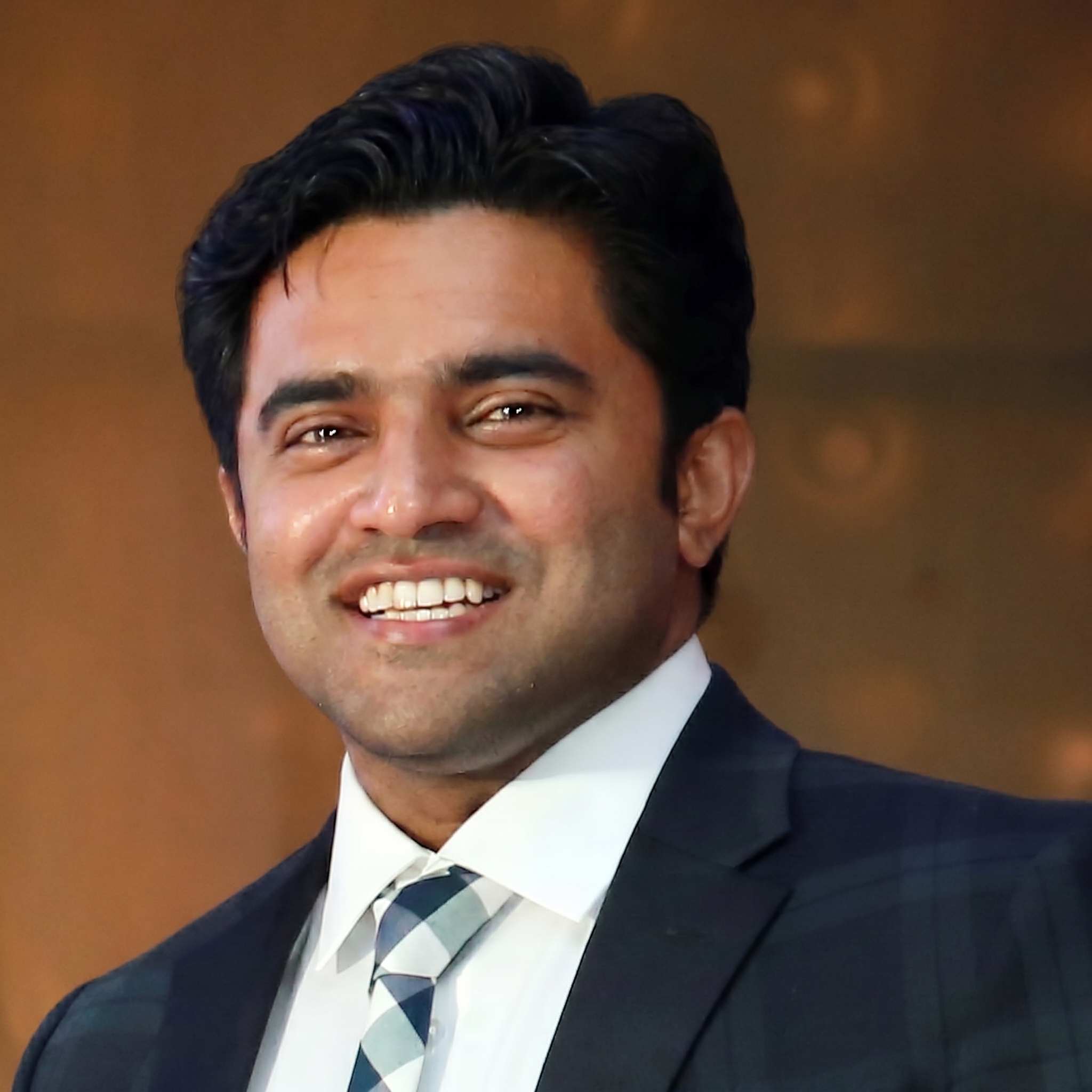
Portrait of Vinod Jose
Vinod Jose
Writing desk
Nov 2025

Public markets are rising for the wrong reasons

A macro note arguing that asset-price strength is being driven less by fundamentals and more by liquidity distortion, with the venture implication that discipline should move toward capital-efficient AI and DeepTech founders.

1 / 8
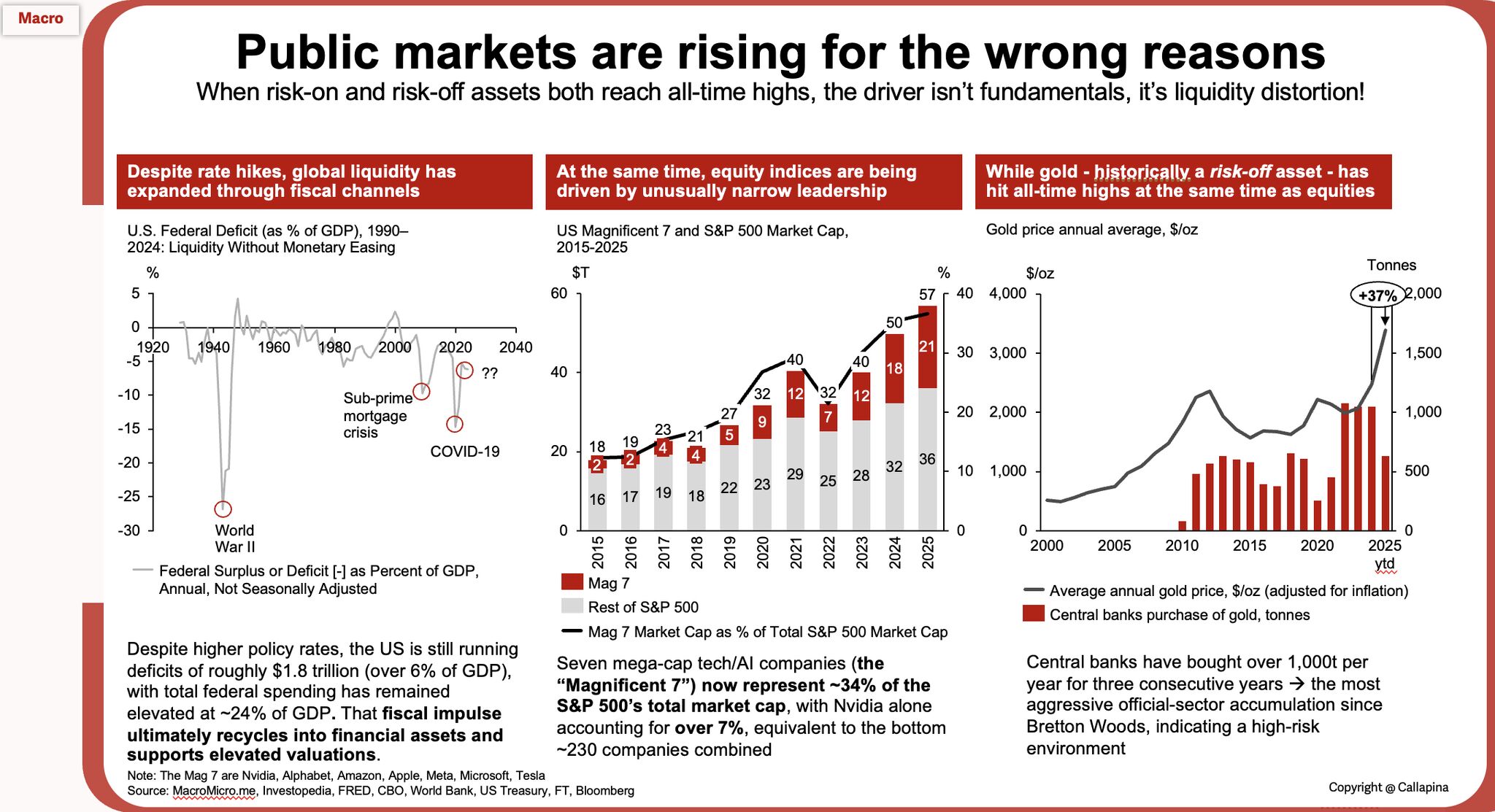
Chart accompanying Vinod Jose's post titled Public markets are rising for the wrong reasons.
Chart from the original LinkedIn post.

When risk-on and risk-off assets both reach all-time highs, the driver is not fundamentals, it is liquidity distortion.

Despite higher policy rates, the US is still running deficits of roughly $1.8 trillion, over 6% of GDP, while total federal spending has remained elevated at roughly 24% of GDP. That fiscal impulse ultimately recycles into financial assets and supports elevated valuations.

At the same time, equity indices are being driven by unusually narrow leadership. Everyone is chasing the Magnificent 7 at 30-40x earnings. The Mag 7 now represent roughly 34% of the S&P 500's total market cap, with Nvidia alone accounting for over 7%, equivalent to the bottom roughly 230 companies combined.

Meanwhile, gold, historically a risk-off asset, has hit all-time highs at the same time as equities, indicating uncertainty and low confidence in the macro environment. Gold has compounded 30%+ annually over 2024-2025, while central banks have bought over 1,000 tons per year for three consecutive years, the most aggressive official-sector accumulation since Bretton Woods.

I would rather back the next 7: Indian diaspora founders building real, cash-generating AI and DeepTech businesses at sane early-stage valuations.

Source link ->
Archive

Longer-form essays from the archive.

India macro, LP education, and cross-border essays collected under the same writing surface.

5 pieces
LP educationLP education

Investing in Innovation: should you go direct, or trust the fund?

The decision to invest in startups should not be taken in isolation; it should be in relation to the rest of your portfolio. Direct vs. fund is a question of expertise, time, and conviction — not just returns.

Read
India macroIndia macro

The Evolution of India's Technology Landscape: From IT Services to Global Innovation Hub

India's technology ecosystem has moved through several compounding waves: IT services, enterprise software, marketplaces, vertical SaaS, fintech, Bharat SaaS, and now the next generation of AI, DeepTech, climate, healthcare, and India-first platforms.

Read
India macroIndia macro

Why US investors should look beyond borders: the Indian opportunity

In today's interconnected economy, limiting investments to familiar domestic markets means missing out on the most consequential growth story of the next decade. India is the prime candidate for diaspora-aware US capital.

Read
India macroIndia macro

Cross-border innovation: US-India collaboration in startups

Bilateral US-India trade reached $146B in 2019 and continues to compound. The US-India startup collaboration sits on top of that foundation — and is rewriting how the most consequential companies of the next decade will be built.

Read
ThesisThesis

"We are early stage, sector agnostic" — what does that mean?

Callapina started with a simple principle: support Indian startups early, where relatively limited capital and high-conviction help can make a real difference. Sector agnostic does not mean without a view; it means staying open while sharpening pattern recognition.

Read