Why US investors should look beyond borders: the Indian opportunity
In today's interconnected economy, limiting investments to familiar domestic markets means missing out on the most consequential growth story of the next decade. India is the prime candidate for diaspora-aware US capital.

The global perspective
Beyond Silicon Valley, there are global hubs of innovation creating significant value. Looking outside the US is no longer optional — it is a practical lever for diversification, growth-rate exposure, and innovation arbitrage.
Diversification. Geographical diversification can reduce portfolio volatility by up to 30% (MSCI). Growth potential. The IMF projected emerging markets to grow 4.7% in 2023 versus 1.4% for advanced economies. Innovation arbitrage. Different markets adopt technologies at different speeds — mobile payments are more widely adopted in India and China than in the US, opening fertile ground for fintech innovation.
The Indian advantage
A booming startup ecosystem
In 2022, Indian startups raised over $44 billion in funding, surpassing the previous year's record. As of October 2023, India is home to 108 unicorns with a total valuation of $340.79 billion and ranks third behind the US and China.
Talent arbitrage
India produces approximately 1.5 million engineering graduates annually. The average annual salary for a software engineer in India is around $10,000, compared to $110,000 in the US — allowing startups to operate more efficiently and investors to stretch capital further. India is also the second-largest English-speaking country, facilitating seamless collaboration with international partners.
A massive and growing market
With a population of 1.4 billion and over 50% under the age of 25, India is a tech-savvy young democracy. Internet users are expected to reach 974 million by 2025. The Indian middle class is projected to reach 583 million people by 2025, fueling consumer demand across sectors.
Digital leapfrogging
India's Unified Payments Interface (UPI) processed over 10.24 billion transactions worth $170 billion in July 2023 alone. With over 1.2 billion mobile subscribers, India is leapfrogging traditional infrastructure, going directly to advanced technologies. The Indian e-commerce market is expected to reach $200 billion by 2026.
Capital efficiency and favorable valuations
Indian startups often operate with significantly lower burn rates than their US counterparts. Bain & Company found that early-stage investments in India have delivered an average IRR of 25% over the past decade. Average Series A valuations in India are around $10 million, compared to $22 million in the US — meaningful entry-point efficiency for the same growth potential.
Foreign investment trends
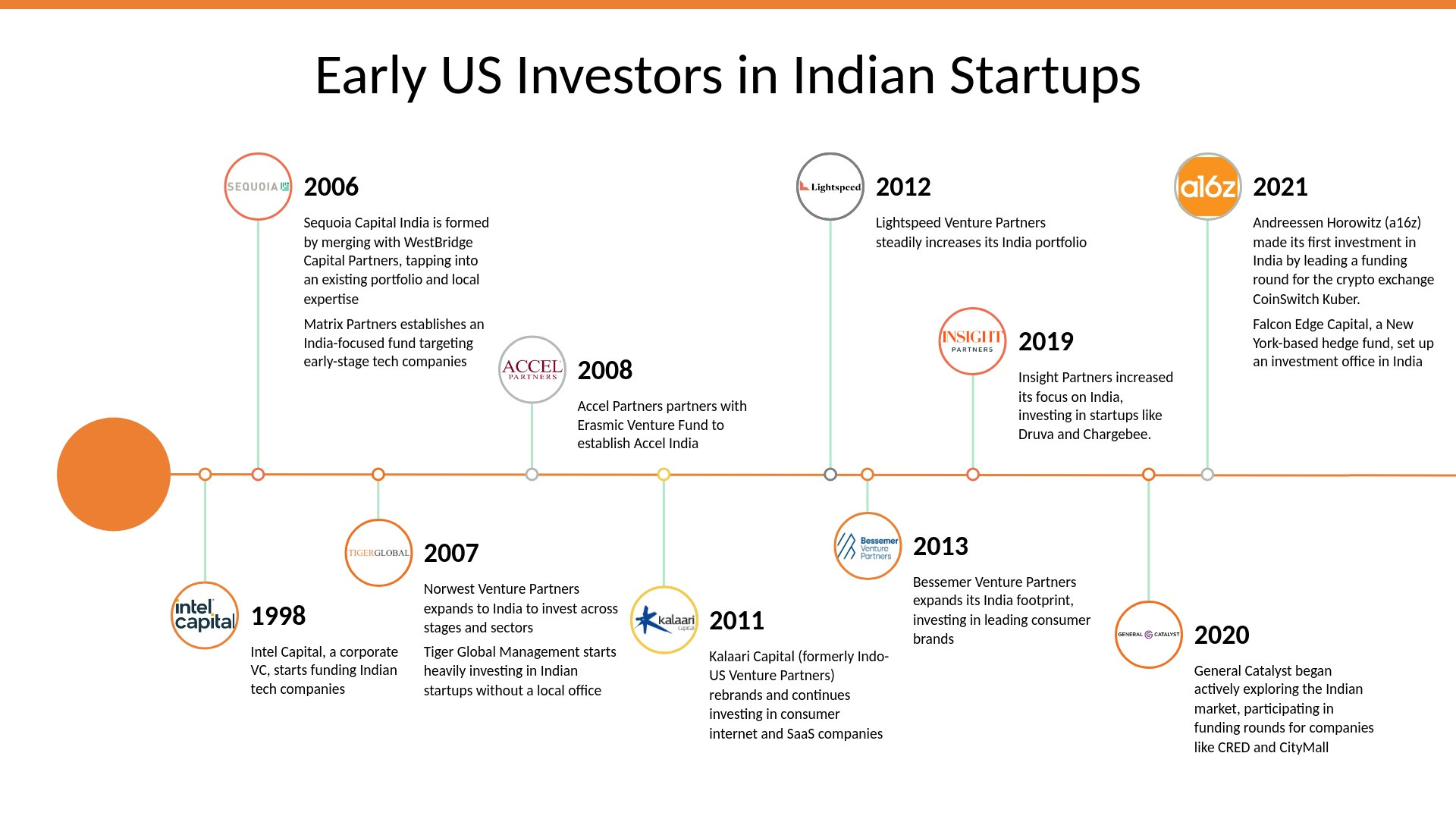
In 2022, foreign investors participated in deals worth $35 billion in Indian startups. The number of active foreign venture capital firms in India grew from 111 in 2018 to over 220 in 2023. US-based firms — Sequoia, Accel, Tiger Global, SoftBank — have made substantial commitments. Sequoia Capital India raised a $2.85 billion fund in 2022, its largest ever for the region.
Challenges to acknowledge
The Indian opportunity comes with real challenges: a complex and evolving regulatory landscape, cultural and consumer-behavior nuances (cash-on-delivery still matters), competitive intensity in mature sectors, exit-route dynamics that differ from the US, and infrastructure gaps that affect logistics and supply chain efficiency.
The Callapina approach
We've built our practice around navigating these realities while capturing the upside:
- Forging partnerships. We collaborate deeply with our founders, available for both strategic decisions and crisis moments.
- Sector focus. We concentrate on areas where India has a structural advantage — vertical AI, deeptech, healthtech, climate tech, India consumption.
- Due diligence. Our process integrates market analysis, founder fit, and legal/compliance review to mitigate risks specific to the corridor.
- Value-add. Beyond capital, we offer strategic guidance, customer introductions, and follow-on capital signal through our domestic and diaspora networks.
- Cross-border synergies. We look for startups whose business models leverage both Indian and US markets — operating efficiency from India, distribution from the US.
The Indian startup ecosystem offers a compelling combination of talent, market size, digital adoption, and growing foreign-investor interest. As with any investment, thorough due diligence and a nuanced understanding of the market are crucial. But for those willing to look beyond familiar borders, the Indian landscape is one of the most consequential frontiers for value creation in the next decade.
The question isn't whether you can afford to invest in India. It's whether you can afford not to.
— Vinod Jose, Founding GP
Suggested articles
The Evolution of India's Technology Landscape: From IT Services to Global Innovation Hub
India's technology ecosystem has moved through several compounding waves: IT services, enterprise software, marketplaces, vertical SaaS, fintech, Bharat SaaS, and now the next generation of AI, DeepTech, climate, healthcare, and India-first platforms.
Cross-border innovation: US-India collaboration in startups
Bilateral US-India trade reached $146B in 2019 and continues to compound. The US-India startup collaboration sits on top of that foundation — and is rewriting how the most consequential companies of the next decade will be built.
How we exited Aisle — anatomy of a deal
Info Edge — parent of Naukri, 99acres, and Jeevansathi — bought 76% of Aisle in March 2022 for ₹91 crore, then walked the stake to 100% over the next three years. The deal validated a thesis that Indian consumer-internet incumbents would pay strategic prices for high-intent vertical brands. And it brought us back the founder twice — once at exit, then again as the founder of Jamm in our Fund I portfolio.
See the rest of our portfolio, the four-pillar thesis behind every bet, and our public track record.