The Evolution of India's Technology Landscape: From IT Services to Global Innovation Hub
India's technology ecosystem has moved through several compounding waves: IT services, enterprise software, marketplaces, vertical SaaS, fintech, Bharat SaaS, and now the next generation of AI, DeepTech, climate, healthcare, and India-first platforms.
The Indian startup ecosystem has experienced a dynamic transformation over the past several decades. This journey can be broken into distinct phases, each shaped by market demand, technology shifts, and the kind of companies that emerged to solve the most urgent problems of that moment.
To predict the next decade of Indian innovation, it helps to understand the sequence of problems India has already solved.
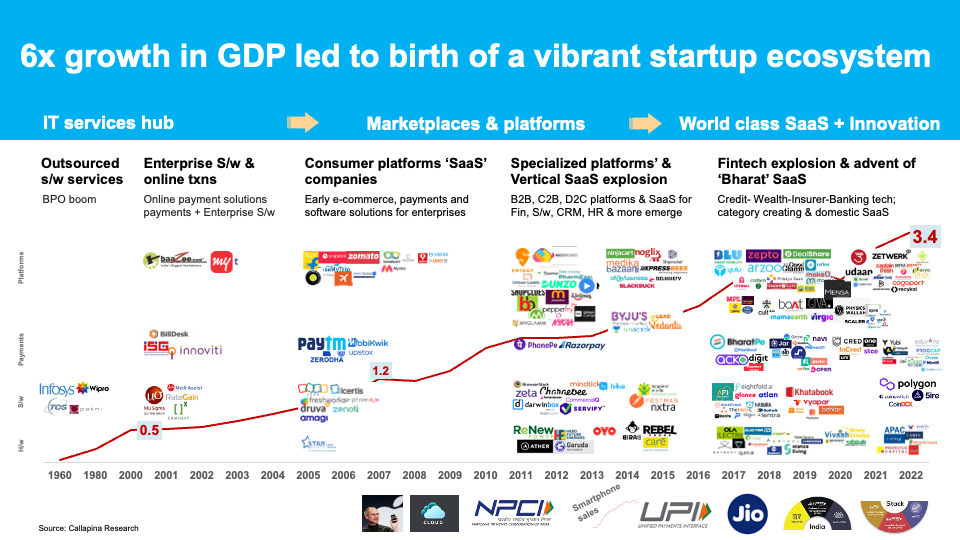
1. IT services hub: 1960-2001
The early growth of India's technology sector was driven by IT services, built primarily around the outsourcing needs of Western corporations.
Major firms like Infosys, TCS, and Wipro emerged during this era, solving for cost-efficient software development, business process outsourcing, and high-quality delivery at global scale.
This phase marked India's emergence as a global IT powerhouse. It established the country's credibility as a technology talent base and created the operating foundation for the entrepreneurial waves that followed.
2. Enterprise software and online transactions: 2001-2007
As global commerce moved online, Indian companies began building enterprise software and transaction infrastructure.
This phase saw the rise of digital payments, business software, and early online consumer platforms. Companies like BillDesk and Innoviti solved foundational problems around secure payment processing and digital transactions.
The core shift was from outsourced services to product-oriented technology that could serve businesses and consumers directly.
3. Marketplaces and SaaS consumer platforms: 2007-2013
The rise of internet penetration and mobile adoption gave birth to consumer platforms across ecommerce, food delivery, travel, mobility, and payments.
These companies solved problems around accessibility, convenience, discovery, trust, and payment integration for Indian consumers.
Key companies from this wave include Flipkart, Zomato, Ola, and Paytm. At the same time, B2B SaaS companies began serving small and medium-sized businesses with software for CRM, HR, finance, customer support, and workflow management. Freshworks became a global reference point for Indian SaaS.
4. Specialized platforms and vertical SaaS: 2013-2019
By the mid-2010s, the ecosystem matured further. More specialized platforms and vertical SaaS businesses emerged in fintech, education, logistics, commerce enablement, healthcare, and business operations.
These companies addressed problems around automation, scalability, and industry-specific workflows. Razorpay, for example, solved payment gateway and financial infrastructure problems for businesses.
This was also the period when founders became more comfortable building for narrow, high-value use cases instead of only broad horizontal platforms.
5. Fintech explosion and Bharat SaaS: 2019-present
The most recent phase has seen an explosion in fintech and the emergence of Bharat SaaS: platforms built for the unique needs of India's non-urban markets, small businesses, and digitally new users.
These startups solve for financial inclusion, credit access, insurance, merchant enablement, digital banking, compliance, and productivity for consumers and businesses across India.
Key companies from this wave include Zerodha, Razorpay, PhonePe, Zetwerk, Giva, Meesho, and boAt.
The important point is that India's market is no longer just copying global categories. It is producing India-specific operating models that can later travel to other India-like markets.
What companies will emerge in the next decade?
As India continues its growth path, a new set of problems will become the foundation for the next generation of valuable companies.
Sustainability and clean tech
Climate change, energy transition, air quality, water scarcity, waste management, and carbon reduction are large and urgent problems.
India will need companies working on renewable energy, carbon markets, clean water, clean air, circular economy infrastructure, and industrial decarbonization.
Agritech and food tech
India remains deeply connected to agriculture. Improving yields, reducing waste, strengthening farmer incomes, and digitizing supply chains will be critical.
AI-driven agritech, precision farming, cold-chain infrastructure, input optimization, and supply-chain software will all matter.
Healthcare and biotech
Affordable healthcare, preventive diagnostics, remote medical access, and rural care delivery remain major challenges.
Healthtech companies focused on telemedicine, AI diagnostics, care coordination, school and workplace health, and biotech innovation can solve problems at massive scale.
DeepTech and AI
As manufacturing, logistics, financial services, healthcare, and enterprise operations become more automated, demand will rise for AI, robotics, IoT, cybersecurity, and applied DeepTech.
India has the talent base to build global products in these categories, especially where high-quality engineering and cost discipline are both advantages.
BharatTech platforms
With the rise of mobile internet and digital public infrastructure, there is growing demand for solutions that serve Bharat: India's rural, semi-urban, vernacular, and digitally emerging users.
The next wave of BharatTech companies will offer localized solutions in commerce, education, healthcare, financial services, entertainment, productivity, and trust.
EdTech 2.0
Education still needs affordable, high-quality, personalized learning for students, professionals, and workers transitioning into the digital economy.
The next generation of edtech will likely be more outcome-oriented: AI-driven learning, vocational training, upskilling, testing, credentialing, and employability.
The Callapina view
At Callapina, our focus is on identifying entrepreneurs who are passionate about solving the next set of problem statements.
India's technology journey has already moved from services to products, from local constraints to global ambition, and from horizontal adoption to specialized innovation. The next decade will be defined by founders who understand this history and use it to build companies that solve real, urgent, large-scale problems.
— Vinod Jose, Founding GP
Suggested articles
Why US investors should look beyond borders: the Indian opportunity
In today's interconnected economy, limiting investments to familiar domestic markets means missing out on the most consequential growth story of the next decade. India is the prime candidate for diaspora-aware US capital.
Cross-border innovation: US-India collaboration in startups
Bilateral US-India trade reached $146B in 2019 and continues to compound. The US-India startup collaboration sits on top of that foundation — and is rewriting how the most consequential companies of the next decade will be built.
How we exited Aisle — anatomy of a deal
Info Edge — parent of Naukri, 99acres, and Jeevansathi — bought 76% of Aisle in March 2022 for ₹91 crore, then walked the stake to 100% over the next three years. The deal validated a thesis that Indian consumer-internet incumbents would pay strategic prices for high-intent vertical brands. And it brought us back the founder twice — once at exit, then again as the founder of Jamm in our Fund I portfolio.
See the rest of our portfolio, the four-pillar thesis behind every bet, and our public track record.