"We are early stage, sector agnostic" — what does that mean?
Callapina started with a simple principle: support Indian startups early, where relatively limited capital and high-conviction help can make a real difference. Sector agnostic does not mean without a view; it means staying open while sharpening pattern recognition.
When we started our investment journey, our guiding principle was simple: support Indian startups at an early stage where our limited capital could make a meaningful difference.
That approach made us early-stage and sector agnostic by design. We did not want to limit ourselves to a single industry or domain too early.
In a market like India, where innovation and potential are emerging across many sectors, narrowing the scope from day one can mean missing important opportunities.
Why sector agnostic made sense
Over the years, this openness allowed us to explore a diverse mix of companies that could be financed by venture capital.
That exposure was not accidental. It was a strategic choice to understand the breadth of innovation happening across the Indian startup ecosystem.
Being sector agnostic helped us observe how strong founders behave across categories: SaaS, consumer, healthcare, fintech, climate, DeepTech, infrastructure, commerce, and services.
Openness does not mean randomness
As we went deeper and gained more experience, certain preferences began to emerge.
Our views on markets, founder quality, timing, capital efficiency, and category formation became sharper. We started recognizing patterns that increased the probability of success.
This is the natural evolution of an early-stage investor: begin broad enough to learn, then become sharper without becoming rigid.
From broad exposure to sharper conviction
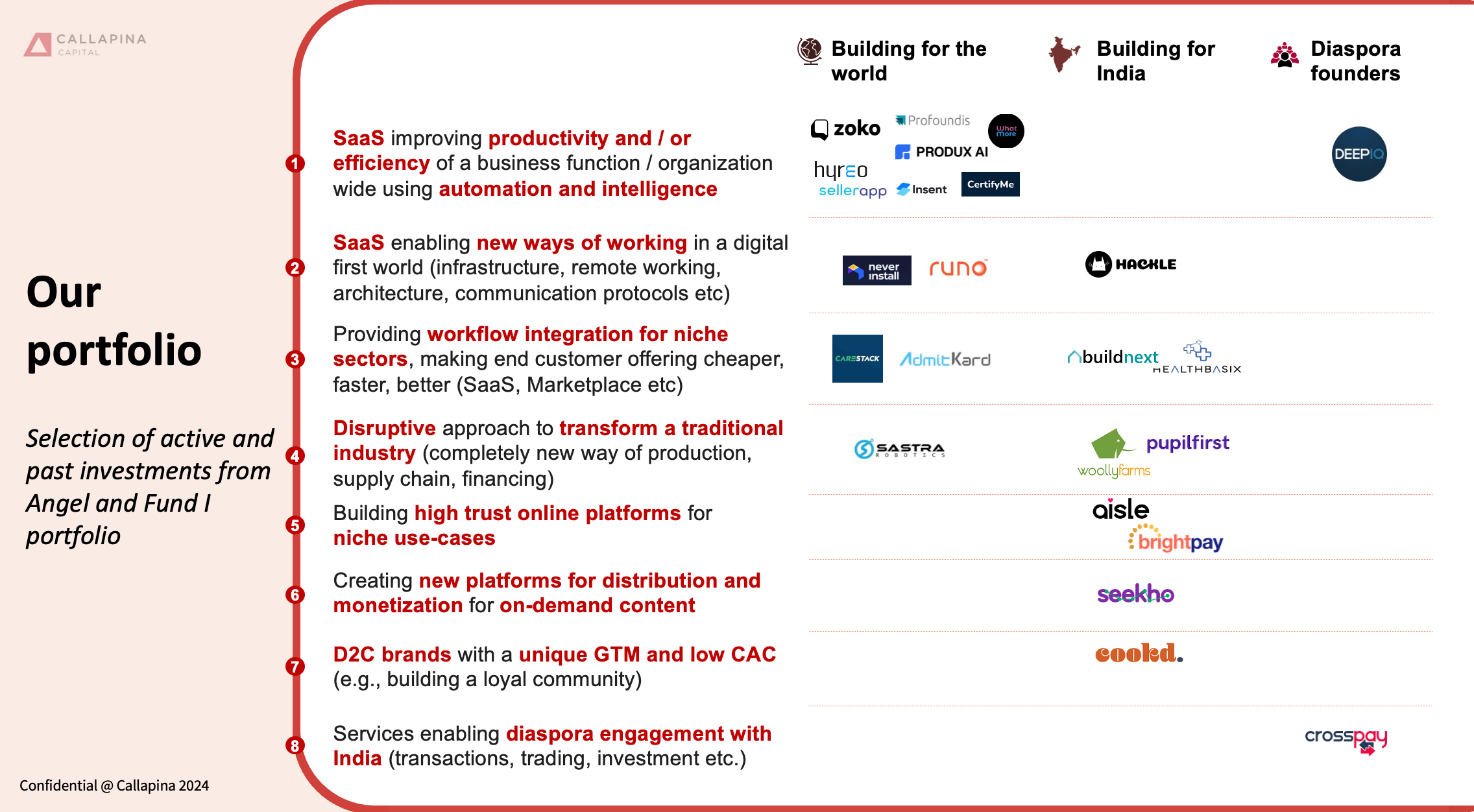
Although it is difficult to distill a multifaceted approach into a simple framework, we have tried to categorize our investments around common angles or plays that have emerged over time.
The framework is not exhaustive. It is a starting point to explain how we think about opportunity, founder-market fit, and the role Callapina can play at the earliest stages.
For us, sector agnostic does not mean thesis-free. It means we are willing to look across sectors while staying disciplined about the underlying question: can this founder build a valuable, durable company in a market that is ready for the solution?
What we mean today
Early stage means we are comfortable backing companies before everything is obvious.
Sector agnostic means we do not force opportunities into a narrow category box.
But our bar remains consistent: resilient founders, large or expanding markets, evidence of customer pull, capital efficiency, and a path to enduring value creation.
That combination is what has shaped Callapina's investing journey so far.
— Vinod Jose, Founding GP
Suggested articles
How we exited Aisle — anatomy of a deal
Info Edge — parent of Naukri, 99acres, and Jeevansathi — bought 76% of Aisle in March 2022 for ₹91 crore, then walked the stake to 100% over the next three years. The deal validated a thesis that Indian consumer-internet incumbents would pay strategic prices for high-intent vertical brands. And it brought us back the founder twice — once at exit, then again as the founder of Jamm in our Fund I portfolio.
How we exited Carestack — anatomy of a deal
Carestack is the headline win on the Callapina angel ledger — eight-year hold, Accel-led Series A brought in by us, $145M+ subsequently raised, full exit. The deal is the cleanest illustration of the four-pillar thesis working in practice: an Indian-data-native vertical, a North-America go-to-market, and an operator-led founder backed before consensus formed.
Why we backed Casa Melhor
Casa Melhor is building the infrastructure layer for enterprise accommodation — dedicated, tech-enabled Business Residences that replace fragmented hotel stays for companies with recurring employee travel.
See the rest of our portfolio, the four-pillar thesis behind every bet, and our public track record.